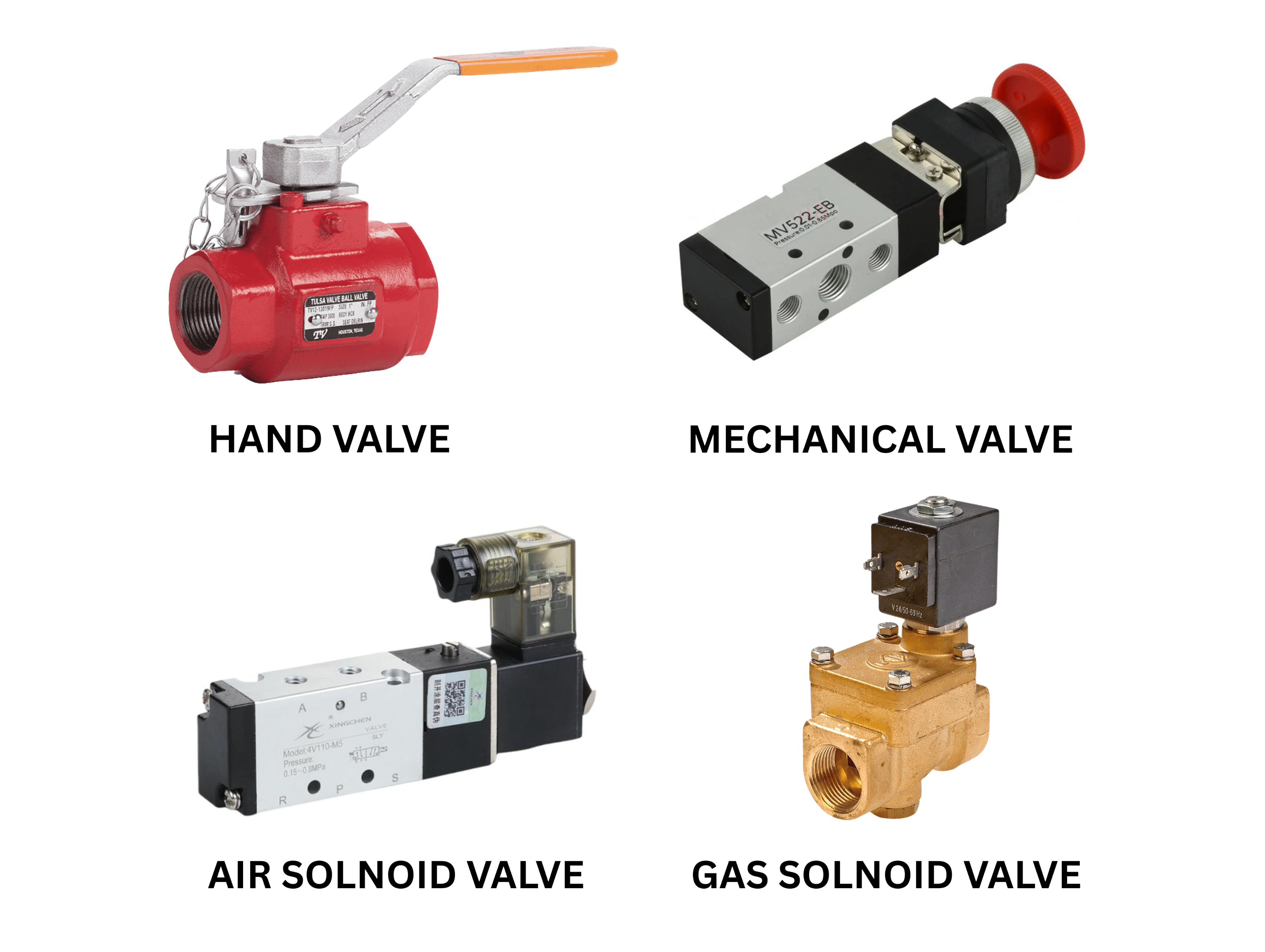
1. Hand & Mechanical Valves
Hand and Mechanical valves are the physical control points of a system. They do not require electricity, making them highly reliable and suitable for environments where power is unavailable or unsafe.
Long Description A Hand Valve (typically a ball valve or lever valve) is the most direct form of flow control. By manually turning a handle, an operator can instantly isolate a section of a pipe for maintenance or safety. These are commonly used in plumbing, air lines, and gas systems as "master" shut-off points.
A Mechanical Valve serves a more specialized role in automation. It is designed to be triggered by the machine itself. For example, when a pneumatic cylinder reaches the end of its stroke, it physically pushes a lever or roller on the valve, which then sends an air signal to the next part of the machine. This allows for simple, robust automation without the need for electronic sensors or software.
2. Air Solenoid Valves
Air solenoid valves are the primary interface between electronic controllers (like PLCs) and physical mechanical motion.
Long Description
An Air Solenoid Valve uses an electromagnetic coil to move an internal spool, which directs compressed air to different ports. In industrial automation, these are the "switches" that tell pneumatic cylinders when to extend or retract. They are available in various configurations, such as $3/2$ way (for single-acting cylinders) or $5/2$ way (for double-acting cylinders). Because they react in milliseconds, they are perfect for high-speed production lines, packaging machines, and robotics where timing must be perfect.
Key Info
- High-Speed Switching: Converts electrical pulses into pneumatic action in milliseconds, supporting rapid production cycles.
- Remote Management: Allows for centralized control of complex machinery from a computer, PLC, or simple push-button.
- Modular Manifold Design: Multiple valves can be stacked together on a single base to save space and simplify air tubing.
- Low Power Logic: Designed to operate on standard industrial voltages like 24V DC or 220V AC with minimal electrical draw.
3. Gas Solenoid Valves
Gas solenoid valves are specialized safety and control devices built specifically to handle combustible or inert gases.
Long Description
A Gas Solenoid Valve is engineered with specific seals (like NBR or Viton) and housing materials to ensure a 100% airtight seal for natural gas, LPG, or propane. Their most critical role is safety; they are often used in "Normally Closed" configurations, meaning the valve stays shut unless it receives power. If there is a power failure or a leak is detected, the valve immediately snaps shut to prevent a fire or explosion. They are found in industrial burners, commercial kitchens, and HVAC boiler systems where precise fuel control is mandatory.
Key Info
- Safety First Design: Typically "Normally Closed," ensuring the gas flow automatically cuts off if power is lost or a safety alarm is triggered.
- Media Specificity: Built with explosion-proof coils and specialized seals that are resistant to the corrosive or drying effects of fuel gases.
- High Flow Capacity: Designed to handle significant volumes of gas with minimal pressure drop, ensuring consistent fuel supply to burners.
- Certified Reliability: Often manufactured to strict safety standards to meet building codes and industrial fire safety regulations.